Previous Day Review
Word / Expression간단 복습
| soundscape | 사람이 실제로 지각하고 해석하는 전체적인 소리 환경 |
| reverberation | 벽·천장 등에 반사된 소리가 공간에 지속되는 현상 |
| acoustic competition | 여러 소리가 동시에 주의를 요구하며 서로 방해하는 상태 |
| cognitive load | 특정 순간에 정보를 처리하는 데 필요한 인지적 부담 |
| spatial zoning | 기능별로 공간을 구분하여 배치하는 설계 방식 |
| The more useful distinction is between A and B | 기존 이분법보다 더 정확한 구분기준을 제시하는 논증 표현 |
| not merely A, but B | 논점을 단순한 A에서 더 본질적인 B로 확장하는 표현 |
IELTS 8.0 Practice: One Strange Particle Event Is Not a Discovery — How Scientists Search for Dark Matter
Introduction
On 1 September 2026, scientists from the LUX-ZEPLIN experiment reported an unusually interesting event from a detector buried deep underground in South Dakota.
A xenon nucleus appeared to recoil in a way that could be consistent with interaction with a WIMP — a weakly interacting massive particle, one of the long-standing candidates for dark matter.
The result immediately attracted attention because directly detecting a dark-matter particle would transform fundamental physics.
But the scientists did not announce that dark matter had been discovered.
The reported significance is about 2.6 sigma, well below the conventional five-sigma threshold used for particle-physics discoveries. Researchers are therefore treating the event as intriguing evidence requiring further investigation rather than confirmation. (Reuters)
Today's topic belongs to Bucket 2 — physics / quantum / materials, focusing on dark-matter detection and scientific evidence.
Today's argument frame
Interesting anomaly versus established discovery
The central distinction is:
Evidence can become more interesting without becoming conclusive.
This is especially important in frontier science, where extremely rare events must be distinguished from equally rare background processes.
Source-Based Background
Dark matter is inferred primarily from its gravitational effects on galaxies and larger cosmic structures. It does not emit or reflect light in the ordinary way, which makes identifying its particle nature exceptionally difficult. Roughly 85% of the universe's matter is thought to be dark matter. (Reuters)
One approach is direct detection. The LUX-ZEPLIN experiment uses about 10 tonnes of liquid xenon deep underground at the Sanford Underground Research Facility. Researchers look for extremely rare particle interactions that might produce characteristic nuclear recoils and flashes of light. (Reuters)
The recently reported event is particularly intriguing because its characteristics are compatible with a possible WIMP interaction. However, one event is insufficient to exclude alternative explanations confidently. Its statistical significance is approximately 2.6 sigma, whereas particle physics conventionally requires around five sigma before claiming a discovery. (Financial Times)
Meanwhile, researchers are expanding the search beyond traditional heavy WIMPs.
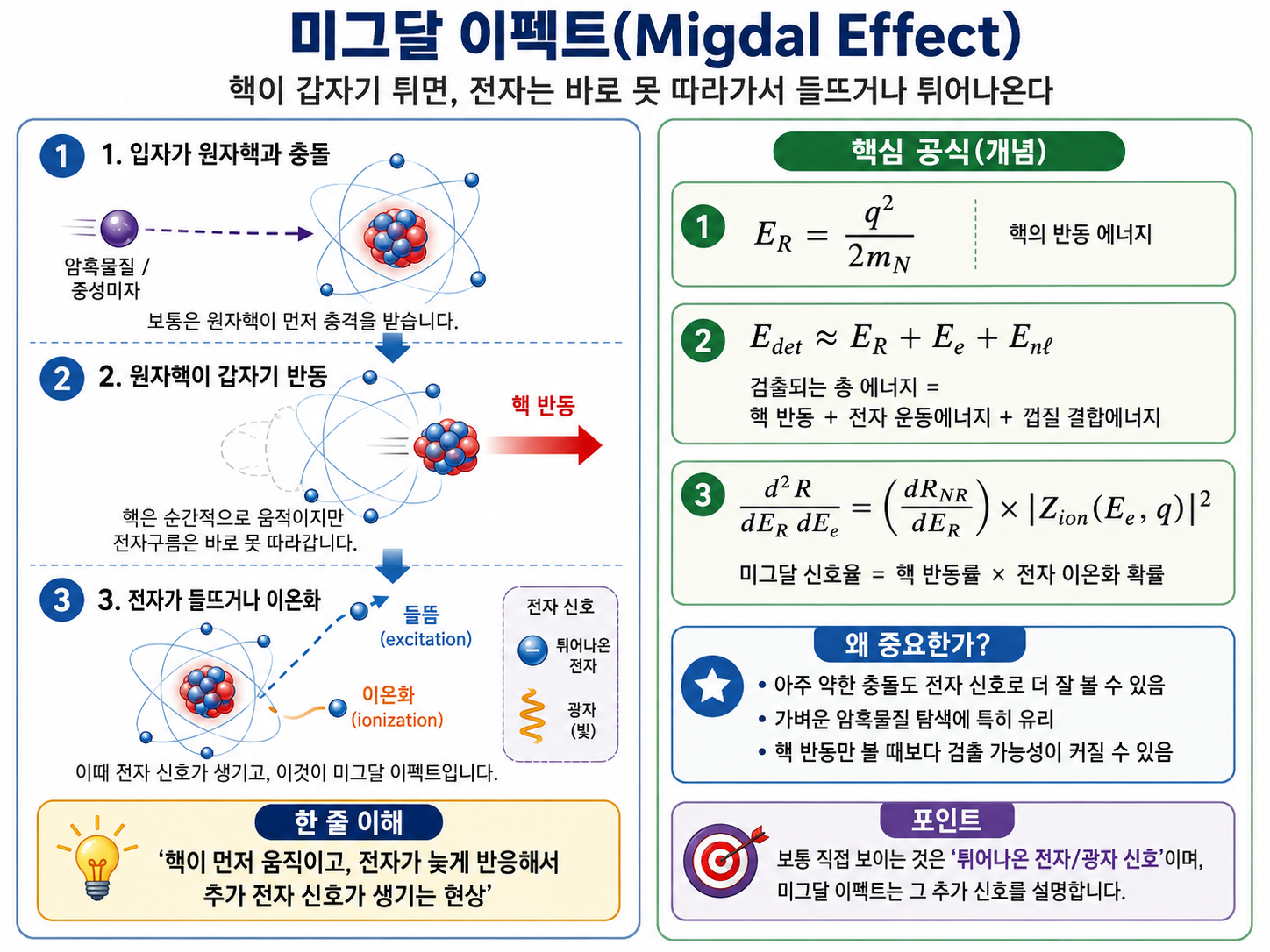
In January 2026, a team reported in Nature the first direct experimental observation of the Migdal effect, achieving five-standard-deviation significance from six candidate events among almost one million recorded events. The Migdal effect occurs when a nucleus suddenly recoils and the resulting disturbance ejects an electron. Confirming this effect strengthens the experimental basis for using it to search for lighter dark-matter particles whose ordinary nuclear recoils may be too weak to detect. (Nature)
Detector technologies are also becoming more sensitive. A July 2026 Physical Review D study reported the first direct dark-matter search using a transition-edge sensor as both target and sensor, testing interactions below the MeV mass scale. (APS Journals)
At CERN's Invisibles 26 conference in August 2026, researchers also presented calculations for using bilayer graphene to search for sub-MeV dark matter through electronic excitations. (Indico)
The frontier is therefore moving in two directions simultaneously:
investigating rare candidate events more rigorously
and
building detectors capable of seeing signals that previous instruments could not detect at all.
Listening
Transcript
Imagine that a detector records one highly unusual event.
Scientists calculate that the probability of ordinary background processes producing something at least this unusual is small.
Should they announce a discovery?
Not necessarily.
Experiments searching for extremely rare phenomena operate for long periods and analyse enormous amounts of data. Even improbable events eventually occur when enough opportunities exist.
Researchers must therefore distinguish between an event that is unlikely under a background model and evidence strong enough to justify a new physical explanation.
Replication matters as well.
If additional events appear with similar properties and independent experiments observe compatible signals, confidence in the new explanation can increase dramatically.
This is why scientific caution should not automatically be interpreted as weakness.
A researcher can regard an observation as extremely interesting while simultaneously refusing to describe it as a discovery.
Indeed, the credibility of frontier science depends partly on maintaining that distinction.
The strongest scientific claim is not necessarily the most exciting interpretation available today.
It is the strongest interpretation that the accumulated evidence can currently support.
Listening Question
Why does the speaker argue that one highly unusual event may still be insufficient for a discovery claim?
A. Rare events cannot be studied statistically.
B. Background processes can occasionally generate unusual events, especially across large datasets.
C. Scientific discoveries require exactly five recorded events.
D. Independent experiments must use identical detectors.
Answer: B
Reading
Passage
Searching Below the Threshold
Scientific instruments do not simply divide nature into things that exist and things that do not.
They divide observations into things they can detect and things they cannot.
This distinction becomes crucial in dark-matter research.
Suppose a hypothetical particle collides with an atomic nucleus but transfers so little energy that the resulting recoil falls below a detector's threshold. The absence of a recorded signal does not establish that the interaction never occurred. It means only that the instrument could not distinguish it reliably from its background.
Scientists can respond in several ways.
One strategy is to reduce the detector's threshold. Another is to search for secondary effects that are easier to observe.
The Migdal effect illustrates the latter approach. When a nucleus suddenly recoils, an electron can occasionally be ejected. Detecting that electron may reveal an interaction whose nuclear recoil would otherwise have been too faint.
This changes the interpretation of experimental silence.
A null result can exclude some theoretical possibilities, but only within the region where an experiment has sufficient sensitivity. Outside that region, the appropriate conclusion may be ignorance rather than absence.
This principle extends well beyond particle physics.
Every measurement system has a domain within which its conclusions are informative.
Scientific progress therefore sometimes occurs not because nature produces a stronger signal, but because researchers learn how to extract information from signals that were previously invisible.
Reading Question
What broader principle does the author use the Migdal effect to illustrate?
A. A failure to detect something can reflect limitations of measurement rather than genuine absence.
B. Secondary signals are always more reliable than direct measurements.
C. Dark matter can only be detected through electrons.
D. Scientific instruments eventually eliminate all measurement uncertainty.
Answer: A
Speaking
IELTS Speaking Part 3 Question
Why do you think people sometimes interpret uncertain scientific findings as definite conclusions?
Band 8.0 Sample Answer
One reason is that scientific uncertainty is difficult to communicate without losing nuance.
Researchers may say that evidence is consistent with a hypothesis, whereas a headline may compress that statement into something much stronger, such as claiming that scientists have discovered the phenomenon.
There is also a psychological preference for categorical answers. Saying that something is either true or false is cognitively easier than understanding probabilities, confidence intervals or competing explanations.
However, uncertainty should not be confused with ignorance. Scientists can have substantial evidence while still withholding a definitive conclusion.
I think scientific communication therefore needs to distinguish more clearly between possibility, evidence and confirmation. Those categories represent different stages of knowledge, and collapsing them can make both discoveries and later corrections appear more dramatic than they actually are.
Writing
IELTS Writing Task 2 Question
Scientific research often produces findings that are promising but uncertain. Some people believe researchers should communicate such preliminary findings widely, while others argue that uncertain results should receive limited public attention until stronger evidence is available.
Discuss both views and give your own opinion.
Band 8.0 Model Essay
Preliminary scientific findings can generate valuable discussion but can also be misunderstood as established knowledge. Although researchers should not conceal uncertain results, I believe public communication should clearly distinguish exploratory evidence from conclusions that have survived extensive verification.
There are strong arguments for early communication. Science progresses through scrutiny, and publishing unexpected findings allows independent researchers to test alternative explanations or design experiments capable of replication. Delaying communication until absolute certainty is reached would also be unrealistic because scientific knowledge is rarely completely final.
The difficulty arises when the public encounters preliminary evidence without its methodological context. A statistically unusual observation may support a hypothesis without establishing it. If this distinction disappears in public reporting, tentative findings can rapidly become perceived facts. Subsequent revisions may then be interpreted as scientific failure rather than the normal process of evidence accumulation.
Restricting all uncertain research would nevertheless create the opposite problem. Important anomalies often deserve attention precisely because they motivate better experiments. What warrants restraint is not uncertainty itself, but a mismatch between the strength of the evidence and the strength of the claim.
Researchers and journalists should therefore communicate uncertainty explicitly. Terms such as candidate event, preliminary evidence and confirmed discovery should not be treated as interchangeable. Where statistical thresholds or alternative explanations remain important, these limitations should accompany the headline conclusion rather than appear only in technical details.
In my view, scientific communication should maximise neither excitement nor caution. Its objective should be proportionality: stronger evidence should permit stronger claims.
Ultimately, public trust is better protected when scientific confidence rises gradually with evidence than when every intriguing observation is temporarily presented as certainty.
Korean Interpretation
오늘의 핵심은 dark matter 자체보다 과학적 증거를 어떻게 해석하는가입니다.
1. Anomaly vs. Discovery
이번 LUX-ZEPLIN 결과처럼 흥미로운 사건이 관측됐다고 해서:
unusual event → discovery
가 되는 것은 아닙니다.
보다 정확한 구조는:
unusual event
→ background explanation 검토
→ statistical significance 평가
→ replication / additional evidence
→ stronger inference
입니다.
즉, 과학적 결론에는 증거의 단계가 존재합니다.
2. Detection Threshold
두 번째 핵심은:
not detected ≠ does not exist
입니다.
실험장비에는 detection threshold가 있습니다.
신호가 너무 약하면 실제 현상이 존재하더라도 장비가 구분하지 못할 수 있습니다.
따라서:
No signal detected
와
No phenomenon exists
를 구분해야 합니다.
이것은 IELTS에서 매우 강력한 사고방식입니다.
3. 오늘 Writing의 논증 구조
Preliminary result 공개의 장점
→ public interpretation에서 발생하는 위험
→ 결과를 숨기는 것 역시 문제
→ uncertainty 자체가 아니라 claim-evidence mismatch가 핵심임을 제시
→ proportional communication이라는 기준 도출
Band 6 수준에서는:
Scientists should be careful when reporting uncertain results.
정도로 쓸 수 있습니다.
Band 8에서는 평가기준을 만듭니다.
The strength of a claim should be proportionate to the strength of the evidence supporting it.
이렇게 쓰면 단순 찬반이 아니라 claim calibration의 문제로 전환됩니다.
4. IELTS 활용
이 논리는 다음 주제에 활용할 수 있습니다.
- 의학 연구
- 경제 전망
- 여론조사
- AI 성능평가
- 범죄 통계
- 교육정책 효과
- 환경 예측
핵심 구분은 다음입니다.
absence of evidence ≠ evidence of absence
단, 이것이 “증거가 없어도 무엇이든 존재할 수 있다”는 뜻은 아닙니다.
중요한 것은 측정도구가 무엇을 탐지할 수 있었는지 먼저 확인하는 것입니다.
Grammar Notes
1. What warrants X is not A, but B
Target structure
What warrants X is not A, but B.
한국어 의미:
X를 정당화하는 진짜 이유가 A가 아니라 B라는 의미입니다.
Example
What warrants regulatory intervention is not technological novelty itself, but credible evidence of substantial harm.
IELTS usage:
문제의 판단기준을 재정의할 때 매우 강력합니다.
2. Rather than + clause
Target structure
X may indicate A rather than B.
한국어 의미:
하나의 현상이 일반적으로 생각하는 B가 아니라 A를 의미할 수 있음을 나타냅니다.
Example
Falling application numbers may indicate demographic change rather than declining confidence in the institution.
IELTS usage:
관찰된 현상에 대한 alternative explanation을 제시할 때 좋습니다.
3. The extent to which
Target structure
The extent to which X can Y depends on Z.
한국어 의미:
X가 Y할 수 있는 정도가 Z에 달려 있다는 표현입니다.
Example
The extent to which remote work can reduce urban congestion depends on how frequently employees would otherwise commute.
IELTS usage:
효과를 단순히 존재/부재로 나누지 않고 degree의 문제로 분석할 수 있습니다.
4. Without + -ing
Target structure
X can occur without establishing Y.
한국어 의미:
X가 발생했다고 해서 Y까지 입증되는 것은 아니라는 표현입니다.
Example
A short-term increase in employment can occur without establishing that an economic reform has improved long-term productivity.
IELTS usage:
상관관계, 단기 결과, preliminary evidence의 과도한 해석을 제한할 때 유용합니다.
Vocabulary Notes
ExpressionMeaning한국어 설명
| dark matter | non-luminous matter inferred largely through gravitational effects | 빛과 거의 상호작용하지 않지만 중력효과를 통해 존재가 추론되는 물질 |
| WIMP | hypothetical weakly interacting massive particle | 암흑물질 후보로 연구되는 약하게 상호작용하는 무거운 입자 |
| nuclear recoil | movement of an atomic nucleus after receiving momentum | 입자 충돌 등으로 원자핵이 반동하는 현상 |
| background event | detector event produced by known or unwanted processes | 찾는 현상이 아니라 방사선 등 다른 원인으로 발생한 검출 신호 |
| statistical significance | measure of how incompatible an observation is with a specified null/background model | 관측값이 특정 배경가설만으로 설명되기 어려운 정도 |
| detection threshold | minimum signal an instrument can reliably distinguish | 장비가 신뢰성 있게 구분할 수 있는 최소 신호 수준 |
| candidate event | observation potentially consistent with a sought phenomenon but not yet confirmed | 찾는 현상일 가능성이 있으나 아직 확정되지 않은 관측 |
| Migdal effect | electron excitation or ionisation following sudden nuclear recoil | 원자핵이 갑자기 반동할 때 전자가 들뜨거나 방출될 수 있는 현상 |
Conceptual Distinction
Evidence ≠ Confirmation
Evidence
→ 특정 설명의 가능성을 높이는 관찰
Confirmation
→ 경쟁 설명을 충분히 배제하고 훨씬 강한 결론을 정당화하는 단계
따라서:
A result can be scientifically important before it is scientifically conclusive.
이 구분은 IELTS에서 science, medicine, economics 관련 Task 2에 매우 유용합니다.
Final Key Sentence
Good science advances not by treating every anomaly as a discovery, but by designing increasingly powerful tests that determine which anomalies survive alternative explanations.
Sources
- Reuters — Scientists make potential breakthrough in search for dark matter, published 1 September 2026 — LUX-ZEPLIN 연구진이 South Dakota의 underground detector에서 WIMP interaction과 일치할 가능성이 있는 단일 사건을 조사하고 있다고 보도했습니다. 연구진은 아직 discovery threshold에 도달하지 않았음을 명확히 하고 있습니다. (Reuters)
- Nature, Vol. 649 (January 2026), Direct observation of the Migdal effect induced by neutron bombardment — 약 100만 건의 기록 중 6개 candidate events를 통해 Migdal effect를 **5 standard deviations의 significance로 직접 관측했습니다. 이는 light dark-matter searches에서 Migdal effect를 활용하는 실험적 근거를 강화합니다. (Nature)
Nature — Direct Observation of the Migdal Effect - Physical Review D 114 (7 July 2026), First direct search for light dark matter interactions in a transition-edge sensor — 약 0.2-ng TES 장치를 target과 sensor로 동시에 활용한 489-hour experiment를 통해 MeV 이하 dark-matter interactions에 새로운 제약을 제시했습니다. (APS Journals)
Physical Review D — Transition-Edge Sensor Dark Matter Search - CERN Invisibles 26 — Dark Matter Direct Detection Using Bilayer Graphene, presented 11 August 2026 — bilayer graphene의 electronic excitation을 이용해 traditional detectors의 sensitivity 아래에 있는 sub-MeV dark matter를 탐색하는 방법과 galactic dark-matter wind에 따른 daily modulation 가능성을 제시했습니다. (Indico)
- Kumar et al., Journal of High Energy Physics (9 July 2026), Direct detection of electromagnetically interacting ultraheavy dark matter — 기존 xenon, argon, semiconductor 및 bubble-chamber detector 결과를 이용해 매우 무거운 dark-matter parameter space에 대한 constraints를 분석하며 현재 direct-detection programme의 넓은 질량 범위를 보여줍니다. (Springer)
Springer Nature — Ultraheavy Dark Matter Direct Detection
Hashtags
#IELTS8 #IELTSWriting #IELTSSpeaking #AcademicEnglish #DarkMatter #ParticlePhysics #ScientificEvidence #CriticalThinking #아이엘츠공부 #암흑물질 #과학적사고 #고급영어